
China AIDC 2026
Build, Baby, Build

Today’s article provides a brief update on China’s AI Data Center (AIDC) buildout and a few interesting opportunities.
I tweeted a few times on X @capytalmgmt, but I would like to provide a more organized summary on Substack as well.
Before we dive in: This is not investment advice. Please do your own research. And if you would like to comment, please be respectful to capybaras; they deserve it.
China’s AIDC Buildout
On a random Sunday, I came across a TikTok (the first TikTok I ever watched) describing the state of China’s AIDC development. A few interesting points (all dollar amounts in RMB unless otherwise stated):
China’s temporary underinvestment: Industry experts said out of the original $400b in 2025 budgeted capex by Chinese hyperscalers (excluding SOE telecoms), only $200b were deployed in Q1-Q3 2025 due to chip export restrictions and a lack of domestic substitutes. China’s current AIDC capacity (defined by data centers capable of handling GPU clusters, not just basic hosting services) is estimated to be less than 1GW.
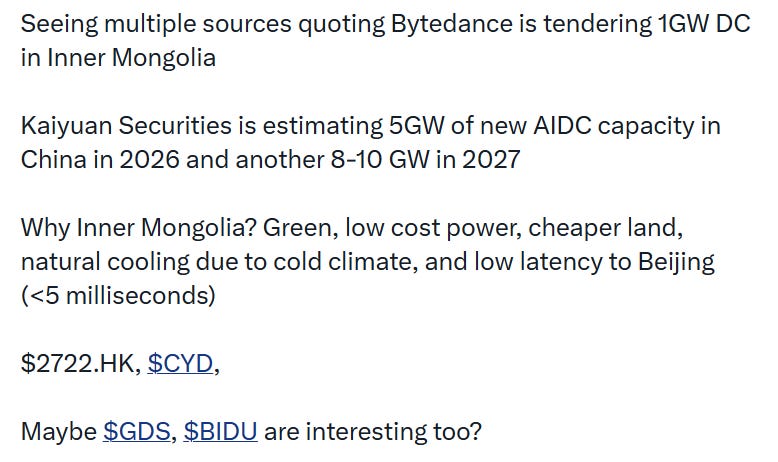
ByteDance’s Tender Offer: According to multiple sources, ByteDance is rumored to have tendered for 1GW of AIDC capacity in Inner Mongolia and Shanxi. The company is expected to invest in at least 1.2GW domestically in 2026. ByteDance is budgeted to invest $160 billion in data center capex in 2026, up from $150 billion (although many said they spent much less than $150 billion in 2025 due to the chip restrictions).
H200 permission, domestic chips: Potential H200 supply, along with domestic chips, are the major catalysts for resuming the delayed buildout plans. H200 is mainly for training, and domestic chips are for inference. Analysts estimate 3-4 million domestic chips would be available for 2026 after a minimal amount in 2025.
Major step-up in capacity: As a result, 5-8GW of AIDC is expected to be built in 2026, with an additional 8-10GW in 2027.
Where to Build, and Why?
The next question is, why Inner Mongolia and Shanxi? Here are the determining factors for site selection:
Power and land cost: Since electricity is 60-70% of AIDC’s operating expenses, the lower the power cost, the better. Land costs depend on location (the closer to Tier 1 cities, the more limited the land supply and the higher the land cost)
Latency: This depends on whether the data center is built for training or for inference. For training, latency is not as important as inference, where real-time data without lag is often critical.
Government support: Local government policies, national government policies (East Data, West Compute), permitting, approvals.
Climate: The cooler the region, the less power needed to cool data centers.
Inner Mongolia and Shanxi
Power and land costs: Inner Mongolia has abundant solar and wind power generation, with coal as baseload power. Shanxi is known for its coal production and is rapidly transitioning towards green energy. Both can offer GW-scale power generation at 30-50% lower costs compared to Eastern China.
Latency: Inner Mongolia’s Horinger County (和林格爾) and Ulan Chab (烏蘭察布) are in proximity to the Beijing-Tianjin-Hebei (BTH) economic circle, with a latency of 2-4.5 milliseconds (ms). Shanxi’s Taiyuan (太原) and Datong (大同) have higher latency (5ms) to BTH, but are also key overflow regions for Beijing’s computing demand.
Government support: Inner Mongolia is one of China’s eight national data hub clusters under the East Data, West Compute Initiative. Shanxi’s local government is very supportive of AIDC development, with fast-track permitting, land approvals, and robust energy infrastructure.
Climate: Both regions have cool temperatures, providing natural cooling for energy-intensive computing. This leads to lower energy use and lower Power Usage Effectiveness (PUE), reducing operating costs.
Investment Opportunities
Given the industry backdrop, I would like to mention a few potential investment opportunities. Some have already gone up a bit, but could still be interesting.
Diesel engines
The thesis for diesel engines is that in almost all of China’s high-grade data centers, diesel generators must be installed as backup power.
Chongqing Machinery and Electric ($2722.HK): mentioned a few times before as the largest domestic diesel engine manufacturer. It also owns Chongqing Hitachi Energy Transformer (CHET), one of the top transformer manufacturers in China, with 40% of revenue from exports. Transformers are highly demanded products globally due to an aging grid. This business still trades at 10x forward P/E with multi-year industry tailwinds.
China Yuchai International ($CYD): Chongqing’s competitor in diesel engines, with a partnership with Rolls-Royce, and more exposure to China’s commercial vehicles industry. CYD’s Chairman announced record highs across volumes, revenues, and profits, and numerous initiatives for 2026. CYD already started receiving orders for 2026 as early as Aug/25, given the orderbook was already full for 2025.
My portfolio management strategy this year is to invest in a couple of names within the same theme, paving the way for CYD’s entrance. UBS recently initiated coverage, giving a target price of $60. Credit to Maius for mentioning and ongoing coverage of the name.
Event-driven ideas
GDS: One of China’s largest carrier-neutral data center developers and operators. Strong long-term partnerships with Alibaba, Tencent, and ByteDance. Also owns 36% of their international business, DayOne. DayOne is backed by prominent investors, such as Hillhouse, Baupost, and Coatue. DayOne recently raised US$2b Series C financing and has a plan to eventually IPO.
China’s domestic chips are capable of AI inference, and GDS has access to 900MW of power-approved land bank in Tier 1 cities, where location, access to power, and latency are vital for inference. They also conducted a C-REIT IPO in 2025 by selling mature data centers to the REIT. Given the buoyant A-share market, their mature data center pipeline is bound for a re-rating once sold to the REIT. The near-term catalyst is H200 approval. Mid-term catalyst is the DayOne IPO.
Baidu: Despite Baidu’s core search business being in a terminal decline, Baidu owns 59% of Kunlunxin, one of the leading Chinese AI chip developers with compatibility with Nvidia's CUDA software platform. 50% of its revenues are external, with major customers such as China Mobile and China Merchants Bank. In fact, they won a $1b order from China Mobile, a significant order for a business that generated $3.5b in annual revenue in 2025. On Jan 2, 2026, Baidu announced a proposed spin-off and separate listing on the Hong Kong Stock Exchange. A re-rating could occur if the IPO prospectus presents an attractive chip business.
Thank You For Reading!
Hope you enjoyed the article. Please share, comment, subscribe, or pledge your support by donating to this page if you find it interesting!
Feel free to leave a comment on X as well! @capytalmgmt
Seems like you have had a few changes - another portfolio update would be appreciated!
Solid breakdown of the infrastructure bottleneck finally opening up. The Inner Mongolia site selection logic makes alot of sense when power costs are such a huge chunk of OpEx. Worked ona project where data center cooling ended up dwarfing compute costs in warmer regions, so that natural cooling advantage is probly more valuable than people realize. The domestic chip timeline for inference workloads could be the real wildcard here if quality stays consistent.